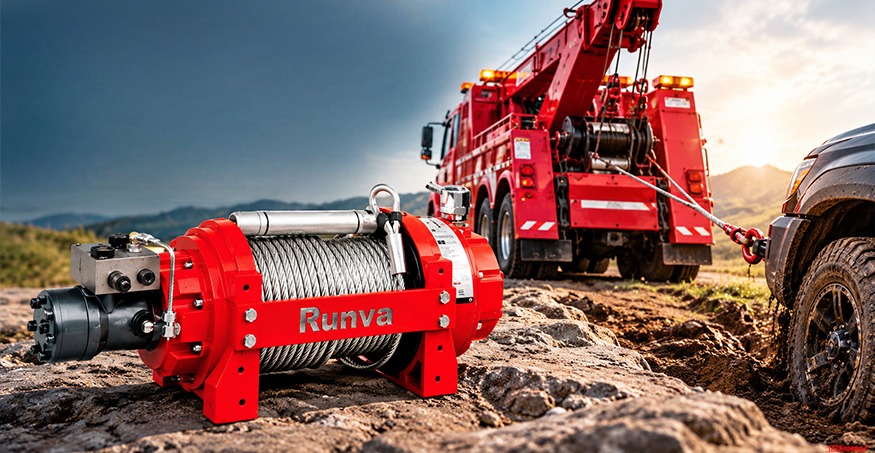
A towing winch looks simple from the outside: a drum, a rope and a motor. Inside, it is a carefully balanced system of torque, gear ratios, braking forces and material strength, all working together to move loads many times heavier than the winch itself. In the UAE, where vehicles face soft desert sand, steep wadi tracks, 50°C summers and demanding industrial schedules, getting that engineering right is not a luxury. It is the difference between a smooth recovery and a dangerous failure.
This technical guide explains how towing winches work, the main types and components, how to size a winch correctly, what UAE conditions demand from winch design, and how to choose a reliable manufacturer and supplier.
What is a towing winch?
A towing winch is a mechanical device that uses a powered or manually driven drum to wind in (or pay out) a wire rope or synthetic rope, creating a controlled pulling force. That force is used to drag, lift, position or recover vehicles and equipment.
The key performance figure is rated line pull: the maximum force the winch can exert on the rope, usually measured on the first layer of rope on the drum. It is typically expressed in kilograms, pounds or kilonewtons.
Where towing winches are used in the UAE
- Recovery and tow trucks: loading broken-down vehicles onto flatbed recovery trucks and pulling vehicles out of ditches or sand
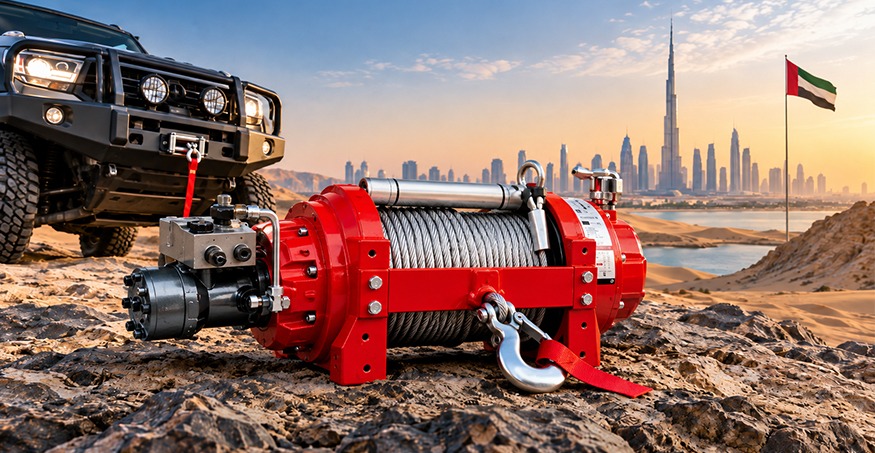
- Off-road and desert vehicles: self-recovery for 4x4s in the dunes of Liwa, Al Faya and the Empty Quarter fringes
- Car carriers and trailers: pulling non-running vehicles up ramps onto trailers
- Construction and mining: positioning equipment, pulling cables and moving materials on quarry and site roads
- Oil, gas and utilities: pipe pulling, cable laying and equipment recovery at remote sites
- Marine and ports: boat launching and recovery, mooring and cargo handling
- Defence and emergency services: heavy vehicle recovery and rescue operations
Types of towing winches by drive system
Electric winches
Electric winches are powered by the vehicle’s 12V or 24V DC electrical system. They are compact, easy to install and can operate even when the engine is off, which makes them the most common choice for 4x4s, light recovery trucks and car trailers.
The trade-off is duty cycle. Electric motors generate heat under load, and long, heavy pulls can overheat the motor or drain the battery. In the UAE’s high ambient temperatures, this limitation becomes even more important.
Hydraulic winches
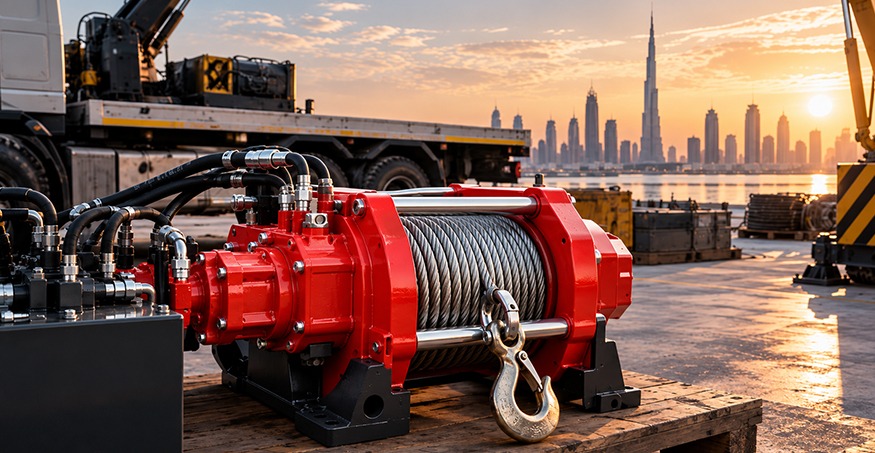
Hydraulic winches are driven by a hydraulic motor powered by the vehicle’s hydraulic system or a dedicated power pack. They deliver high, continuous torque and can run for long periods without overheating, as the hydraulic oil carries heat away from the motor.
This makes them the preferred choice for heavy recovery trucks, rotators, construction equipment and industrial applications. The trade-offs are higher installation complexity, the need for a running engine or power pack, and the cost of hydraulic components.
PTO (mechanical) winches
Power take-off winches are driven mechanically from the vehicle’s gearbox through a PTO unit and drive shaft. They are extremely robust and well suited to continuous heavy-duty work, and are often found on military, agricultural and older heavy recovery vehicles. However, they offer less precise control and require careful mechanical integration.
Pneumatic winches
Air-powered winches use compressed air to drive an air motor. Because they produce no electrical sparks, they are used in hazardous environments such as oil and gas facilities and some marine and mining applications where explosion risk must be controlled.
Manual winches
Hand-cranked winches are used for light loads such as boat trailers and small equipment. They are simple, inexpensive and need no power source, but their capacity and speed are limited.
| Drive type | Typical use | Strengths | Limitations |
|---|---|---|---|
| Electric | 4x4s, light recovery, car trailers | Compact, easy install, works with engine off | Limited duty cycle, heat build-up |
| Hydraulic | Heavy recovery trucks, industry | Continuous high torque, excellent heat handling | Complex installation, needs engine or power pack |
| PTO | Military, heavy-duty vehicles | Very robust, continuous operation | Less precise control, complex integration |
| Pneumatic | Oil and gas, hazardous areas | Spark-free, safe in explosive atmospheres | Needs compressed air supply |
| Manual | Boat trailers, light loads | Simple, no power needed | Low capacity and speed |
Anatomy of a towing winch
Motor
In electric winches, two motor designs dominate. Series-wound motors deliver high torque at low speed and tolerate heavy loads better, making them the standard for serious recovery work. Permanent magnet motors are lighter and more efficient at light loads but heat up faster under sustained heavy pulls. In hydraulic winches, gear motors or orbital (gerotor) motors are common, selected according to the system’s flow rate and pressure.
Gear train
The gear train converts the motor’s high speed and low torque into the low speed and high torque needed at the drum. Three designs are widely used:
- Planetary gears: compact, efficient and able to share load across multiple gears. Most modern recovery winches use a three-stage planetary train.
- Worm gears: offer very high reduction ratios and are often self-locking, which improves load holding, but they are less efficient and generate more heat.
- Spur gears: highly efficient and fast, but usually require a separate, robust brake because they do not hold loads on their own.
The overall gear ratio is a key design choice: a higher ratio increases pulling power but reduces line speed.
Brake
The brake holds the load when the motor stops and controls it while paying out rope. Designs include automatic mechanical (load-holding) brakes inside the drum, disc or band brakes, and, in hydraulic systems, counterbalance valves combined with spring-applied, hydraulically released brakes. A reliable brake is the single most important safety feature on any winch.
Drum
The drum stores the rope. Its diameter and length determine rope capacity and how line pull changes as rope layers build up. A larger drum diameter relative to rope diameter reduces bending stress on wire rope and extends its life.
Clutch (free-spool)
The clutch disengages the drum from the gear train so rope can be pulled out by hand quickly. It must engage positively and stay engaged under load.
Rope: steel wire or synthetic
- Steel wire rope is highly resistant to abrasion and heat, making it well suited to rocky terrain and hot environments. However, it is heavy, can develop sharp broken wires, and stores significant energy that can make it whip dangerously if it fails.
- Synthetic rope, typically made from ultra-high-molecular-weight polyethylene (UHMWPE), is much lighter, easier to handle and stores far less energy, reducing recoil danger. It is more sensitive to abrasion, UV exposure and heat, so it benefits from protective sleeves and careful storage.
Whichever rope you choose, its minimum breaking load must exceed the winch’s rated line pull by a suitable safety margin.
Fairlead
The fairlead guides rope onto the drum. Roller fairleads suit steel wire rope, while smooth hawse fairleads made from aluminium are recommended for synthetic rope to prevent damage.
Controls
Controls range from wired remote switches to wireless remotes, in-cab controls and proportional hydraulic valves. Heavy-duty applications increasingly use variable-speed control for precise positioning.
Sizing a towing winch: the engineering behind the numbers
Choosing a winch by guesswork is one of the most common and costly mistakes. Proper sizing considers load weight, terrain, gradient, rope layers and safety margins.
The quick rule of thumb
For general vehicle recovery, a widely used starting point is:
Rated line pull ≥ 1.5 × gross vehicle weight (GVW)
For a 3,500 kg vehicle, that suggests a winch of at least 5,250 kg rated line pull. This rule is deliberately conservative because real recovery conditions are unpredictable.
The more precise calculation
When conditions are known, engineers calculate the required pull more accurately:
Required pull = W × (sin θ + μ × cos θ)
Where:
- W = weight of the load (kg)
- θ = slope angle
- μ = terrain resistance coefficient
Typical approximate resistance coefficients:
| Surface | Approximate μ |
|---|---|
| Hard paved road | 0.02–0.05 |
| Gravel or compacted track | 0.05–0.10 |
| Firm sand | 0.15–0.25 |
| Soft or deep sand | 0.30–0.50 |
| Deep mud or vehicle buried to axles | 0.50 or more |
These values vary widely in practice, so they should be used as guides rather than exact figures.
Worked example
A recovery truck must winch a 3,500 kg SUV up a 20° slope of soft sand (μ ≈ 0.3).
- sin 20° ≈ 0.342 and cos 20° ≈ 0.940
- Terrain component: 0.3 × 0.940 = 0.282
- Total factor: 0.342 + 0.282 = 0.624
- Required pull: 3,500 × 0.624 ≈ 2,184 kgf
- Apply a 1.5 safety factor: 2,184 × 1.5 ≈ 3,276 kgf
Accounting for rope layers
A winch’s rated line pull applies to the first layer of rope on the drum. As more layers wrap on, the effective drum diameter increases, so the same torque produces less pull:
Line pull on layer n = First-layer pull × (D₁ ÷ Dₙ)
As a practical guide, line pull often drops by roughly 10% with each additional layer, depending on drum and rope diameter. If the pull in our example happens with three layers on the drum, available pull may be around 80% of the rating, so the winch should be rated for at least:
3,276 ÷ 0.8 ≈ 4,100 kgf (about 9,000 lb)
When conditions are uncertain, the higher rule-of-thumb figure (5,250 kg) is the safer choice.
Using a snatch block
A snatch block (pulley) anchored to the load or an anchor point creates a double-line pull that can nearly double pulling force, minus small friction losses, while halving line speed. It also lets the winch work on lower rope layers where pull is highest, and reduces strain on the motor.
Hydraulic winch design calculation
For hydraulic winches, the theoretical line pull can be estimated from the motor torque:
Motor torque (N·m) = Displacement (cm³/rev) × Pressure (bar) ÷ 62.8
Line pull (N) = Motor torque × Gear ratio × Gear efficiency ÷ Drum radius (m)
This calculation helps engineers match the winch motor, gearbox and drum to the truck’s hydraulic pump flow and pressure, ensuring the winch delivers its rated performance in real operation.
Engineering winches for UAE conditions
Winches built for mild climates can struggle in the UAE. Manufacturers serving this market should address:
- Extreme heat: high ambient temperatures reduce an electric motor’s ability to shed heat and shorten duty cycles. Heavy-duty motors, thermal protection, heat-resistant wiring and hydraulic drives for continuous work all help.
- Sand and dust: fine sand can enter gearboxes, bearings and solenoids. Sealed housings, high IP-rated electrical components (IP67 or better is common for recovery winches) and protected control boxes extend service life.
- Coastal humidity and salt: corrosion attacks drums, fasteners and electrical contacts near the coast. Zinc plating, powder coating, stainless fasteners and sealed connectors are essential.
- UV exposure: synthetic rope, cable insulation and plastic parts degrade in strong sunlight, so UV-resistant materials and protective covers matter.
- Battery and electrical load: electric winches can draw several hundred amps under heavy load. Heavy-gauge cables, high-capacity batteries and proper isolation switches prevent voltage drop and fire risk.
Safety and standards
Winches are safety-critical equipment. Reputable manufacturers design and test to recognised standards, such as EN 14492-1 for power-driven winches, and supply clear load ratings, test certificates and operating instructions. Key safety features include:
- A reliable automatic load-holding brake
- Overload protection or thermal cut-out
- Clearly marked rated line pull and rope specifications
- Emergency stop functions on industrial and hydraulic systems
- Rope with a minimum breaking load well above the winch rating
Operators should always use rated recovery points, keep bystanders clear of the rope’s danger zone, use a rope dampener on steel wire rope, and never exceed the rated capacity.
How to choose a towing winch manufacturer and supplier in the UAE
- Engineering capability: can they calculate, design and customise winches for your vehicles and applications?
- Range of drive types: electric, hydraulic and PTO options let you choose the right technology for each job.
- Component quality: ask about motors, gearboxes, brakes, drums and rope suppliers.
- Testing and certification: look for load testing, documented ratings and compliance with recognised standards.
- Integration expertise: proper mounting, hydraulic plumbing and electrical installation are as important as the winch itself.
- Local stock and spare parts: quick access to ropes, solenoids, remotes and seals minimises downtime.
- After-sales service: inspection, repair and maintenance support from a local team.
Maintenance tips for long winch life
- Inspect rope before every use for kinks, broken wires, fraying or abrasion
- Re-spool rope under tension after use to prevent crushing and binding
- Check mounting bolts, fairleads and hooks regularly
- Clean sand and dust from the winch and controls
- Inspect electrical cables, terminals and solenoids for corrosion or loose connections
- Check hydraulic hoses and fittings for leaks and wear
- Operate the winch periodically, even when not needed, to keep components moving freely
- Follow the manufacturer’s service schedule for gearbox lubrication and brake inspection
Frequently asked questions
Should I choose an electric or hydraulic winch for a recovery truck?
For light and occasional recovery, a heavy-duty electric winch is often enough. For frequent, heavy or long pulls, especially in UAE heat, a hydraulic winch is usually the better choice because it can run continuously without overheating.
Is synthetic rope better than steel wire rope?
Synthetic rope is lighter, safer if it breaks and easier to handle. Steel wire rope is more resistant to abrasion and heat. The best choice depends on terrain, usage and maintenance practices.
Why does my winch pull less than its rating?
Rated line pull applies to the first rope layer. With more layers on the drum, low battery voltage, worn components or high motor temperatures, available pull is lower.
How often should a winch be serviced?
Inspect the rope and mounting before each use, and follow the manufacturer’s schedule for full servicing. Winches used in sand, salt air or heavy commercial work need more frequent attention.
Conclusion
A towing winch is a precision system where motor power, gear ratios, braking, drum design and rope strength must all work in harmony. In the UAE’s demanding environment of heat, sand and heavy commercial use, choosing a correctly sized, well-engineered winch protects your vehicles, your cargo and, most importantly, your people.
For businesses looking for a dependable towing winch manufacturer and supplier in the UAE, Creative Engineering Works (CEW) offers the engineering expertise to design, supply and integrate winches suited to recovery trucks, trailers, off-road vehicles and industrial applications. From selecting the right drive system to proper installation and after-sales support, Creative Engineering Works (CEW) helps you get the pulling power you need, safely and reliably. Contact CEW today to discuss the right winch solution for your fleet.