Desert Miles, Real Costs: The Spare Parts Debate That Actually Matters!
Out on UAE highways, where heat shimmers off the asphalt and long hauls are the norm, truck performance isn’t just about power, it’s about survival as the desert heat is intense and relentless. Now imagine what that does to a working truck running hour after hour, carrying heavy loads across long distances. In this environment, performance is only half the story. The real challenge lies in maintenance specifically, how often parts need replacing and how much those replacements cost over time.
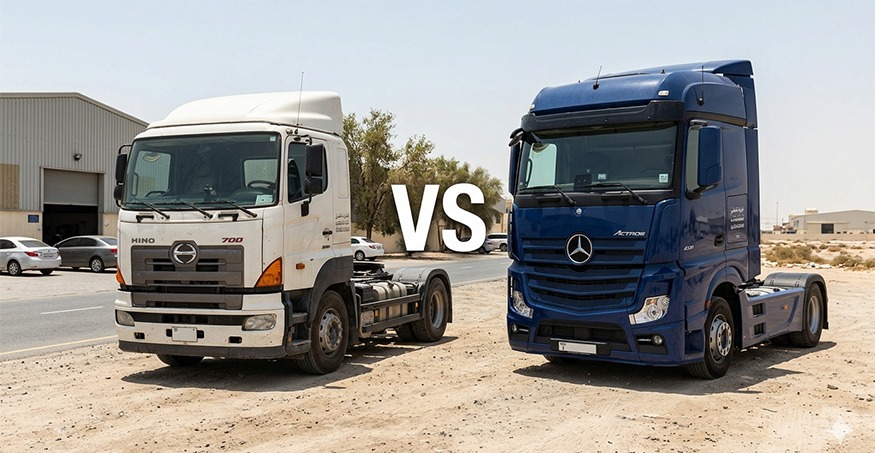
For fleet owners and logistics operators, this isn’t a casual comparison. It’s a daily financial calculation. Japanese trucks are often praised for their practicality and affordability, while European trucks carry a reputation for advanced engineering and premium performance. But when the desert starts to wear things down, which one truly proves more cost-effective? The answer lies not just in price tags, but in how each system responds to the realities of the UAE climate.
Understanding the UAE Operating Environment
Operating a truck in the UAE is very different from running one in milder climates. Temperatures can soar beyond 45°C, it directly impacts mechanical performance. Engines run hotter, cooling systems are under constant pressure, and components like hoses, belts, and filters degrade faster than usual.
Add to that the presence of fine desert dust, which finds its way into air filters, fuel systems, and moving parts, accelerating wear. Long-haul routes between cities further increase stress on engines, brakes, and suspension systems. In this setting, spare parts purchases become part of a continuous maintenance cycle.
Cost-effectiveness, therefore, isn’t just about how much a part costs upfront. It’s about how often it needs replacement, how easily it can be sourced, and how quickly it can be installed to get the truck back on the road.
Japanese Trucks: Reliability and Affordable Maintenance
Japanese trucks have earned their reputation for reliability, especially in the UAE’s demanding conditions. Built with simplicity and durability in mind, they’re easier to maintain and far more forgiving under extreme heat. Spare parts are not only affordable but widely available, which means quicker repairs and minimal downtime. Add to that lower labor costs and straightforward servicing, and you get a system that keeps operations smooth, predictable, and financially manageable.
European Trucks: Advanced Engineering but Higher Costs
European trucks bring premium engineering, advanced technology, and impressive performance to the road. But that sophistication comes at a cost. Spare parts are more expensive, often specialized, and sometimes require import, leading to delays. In the UAE’s harsh climate, this can mean longer downtime and higher repair bills. Their complexity also demands skilled technicians, increasing labor costs and making maintenance a more expensive, carefully managed investment.
Cost Comparison: Short-Term vs. Long-Term
When comparing Japanese and European truck spare parts, the cost difference becomes clear almost immediately.
Short-Term Costs (0–2 Years)
In the UAE, short-term ownership is where the difference is most obvious:
Japanese trucks
- Lower upfront spare part costs
- Faster availability (same-day or next-day in many cases)
- Lower labor costs due to simpler systems
- Routine service: generally cheaper and predictable
European trucks
- Higher initial spare part pricing
- Dealer or specialist dependency
- Labor can be 30–100% higher in some cases
- Delays if parts are imported
Takeaway: Short-term, Japanese trucks can be 30–50% cheaper to maintain in UAE operating conditions.
Long-Term Costs (3–7+ Years)
This is where things get more nuanced.
Japanese Trucks (Long-Term Reality)
- Frequent part replacement due to harsh heat and dust
- But each replacement is relatively inexpensive
- Strong resale value helps offset total ownership cost
- Lower risk of major system failures
European Trucks (Long-Term Reality)
- Parts are engineered to last longer
- Fewer replacements in ideal conditions
- But,
- UAE climate reduces lifespan of high-tech components
- Expensive failures (engine sensors, electronics, transmission systems)
- Repairs can run into thousands of AED per incident
Insight: The UAE environment often cancels out the “longer lifespan” advantage of European parts.
Which Option is More Cost-Effective?
For most businesses operating in the UAE, the balance tends to favor Japanese trucks. Their lower spare part costs, combined with widespread availability and ease of maintenance, make them a practical and financially sustainable option.
The Road-Tested Verdict: What Truly Pays Off in the UAE
At the end of the day, the UAE climate doesn’t just test trucks, it tests business decisions. Choosing between Japanese and European trucks isn’t simply about brand preference; it’s about understanding how each option performs under pressure and how that performance translates into costs.
Japanese trucks stand out for their practicality, affordability, and reliability, making them a strong choice for most operations. European trucks, while impressive in design and capability, require a higher level of investment and maintenance discipline to truly deliver value.
For businesses aiming to keep their fleets moving efficiently without constant financial strain, the decision often comes down to one key factor: how quickly and affordably can you keep your trucks on the road? In the UAE, that question makes all the difference.
FAQs
1. Which truck spare parts are cheaper in the UAE—Japanese or European?
Japanese truck spare parts are generally more affordable and widely available across the UAE. This makes them a cost-effective option for routine maintenance, especially for fleets that require frequent part replacements due to harsh operating conditions.
2. Are European truck parts more durable than Japanese ones?
European parts are often engineered for durability and high performance. However, in extreme climates like the UAE, their lifespan can be affected. Without consistent and proper maintenance, the durability advantage may not always justify the higher cost.
3. Why are Japanese truck parts more easily available in the UAE?
Japanese trucks are widely used across the region, which has led to a strong supply chain. This ensures that spare parts are readily available in local markets, reducing waiting times and helping businesses avoid prolonged downtime.
4. Which trucks are better for UAE weather conditions?
Japanese trucks are generally better suited for UAE conditions due to their reliability, simpler engineering, and ease of maintenance. They handle extreme heat and dusty environments more efficiently with lower overall maintenance costs.